
Judicial Credit or Precatorio? The Brazilian-Market Distinction That Drives the Discount
Why Brazilian judicial credits and precatorios are the same asset at different stages—and why pre-issuance claims carry larger discounts.
Quick read
- One asset, two names. A precatorio is a judicial credit — just at its most advanced stage. The split is a convention of the Brazilian market: practitioners say judicial credit before the payment requisition is issued, and precatorio after. The dividing line is issuance.
- The claim climbs a ladder — disputed calculation → court-approved → final and binding → requisition issued → in the budget. Each rung removes time and risk.
- That is where the discount comes from. The earlier the rung, the larger the discount: more time to payment, more residual risk. Buying earlier is how you reach for more discount — but only if diligence closes that risk. That, not the label, is what separates a good claim from a bad one.
To a U.S. allocator, a Brazilian precatorio looks like a familiar kind of asset: a court-confirmed claim against a government, paid through a constitutional queue — a sovereign-style receivable with a litigation-finance underwriting profile. Anyone sourcing these claims quickly meets two words used almost interchangeably — judicial credit (direito creditório) and precatorio. They are not quite synonyms, and the difference is not academic: it is where the discount (deságio) comes from.
One asset, two names
Start with the legal fact: a precatorio is a judicial credit. "Judicial credit" (direito creditório) is the genus — any court-confirmed claim against a public entity, at any stage of maturity. A precatorio is that same claim at its most advanced stage: once the trial court issues the payment requisition (ofício requisitório) and the claim enters the government's budget under Article 100 of the Constitution.
So why do practitioners talk as if these were two assets? Because the Brazilian market draws a working line at issuance. The people who originate and trade these claims reserve judicial credit for the asset before the requisition is issued — calculation still in dispute, court-approved and awaiting finality, or requisition pending — and switch to precatorio after issuance, when the claim takes a numbered place in the payment queue. It is a convention of the trade, not a change in legal nature: a precatorio never stops being a judicial credit. But the label tells a buyer, at a glance, how far along the asset is — and that drives both the time to cash and the discount.
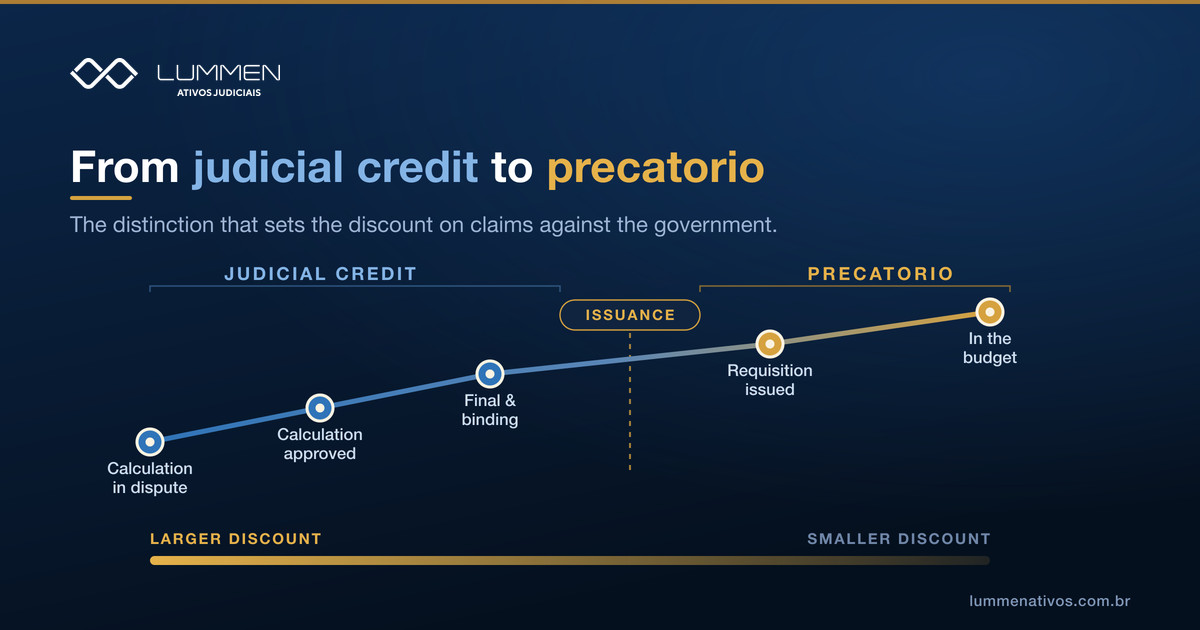
From judicial credit to precatorio: the Brazilian market draws the line at issuance — and the discount is widest before it. Illustration: Lummen.
The maturation ladder
Between "the claimant won" and "a precatorio sits in the budget" runs a defined sequence — for an investor, the duration-and-risk curve the position is priced on (timelines vary by court):
- Calculation in dispute. In post-judgment enforcement against the government (cumprimento de sentença), the claimant files the amount due. While it is contested — by the government, or on the criteria — the amount is not yet fixed. Lowest rung: the right exists, the number does not.
- Court-approved calculation (homologação). The judge ratifies the amount; the claim is now liquidated — "how much?" becomes "this."
- Final and binding (trânsito em julgado). The approval must become unappealable. As a rule the government is served (usually within ~10 business days) and a challenge window of ~30 business days runs. The tell that matters: if the government already agreed to the figure, or proposed it, a surprise appeal in that window is unlikely.
- Requisition issued (expedição). The court issues the requisition. Timing here is processing, not a statutory clock — it turns on the claimant's attorney and the court's docket. This is the issuance line: from here, the market calls it a precatorio.
- In the budget. The requisition is transmitted, the parties are heard (the government gets a doubled deadline), and the claim takes its place in the budget queue, with a deadline and chronological order.
The underwriting lesson: most of the legal risk lives on the first rungs. A claim that is court-approved, undisputed on amount, and moving toward finality is already a mature asset — even before it is, formally, a precatorio.
What makes a good claim
Stage is only half of it; a procedurally advanced claim can still be a poor buy. Three things have to clear:
- The claimant (the assignor). Can they assign, and is the claim clean of liabilities that could reach the proceeds — tax debts, lawsuits, or orders that trigger attachment over the credit? A claimant carrying liabilities can contaminate a claim that looked clean in the docket.
- The legal thesis and the case. Is the underlying matter settled, or is a binding lead-case ruling pending at the higher courts that could reopen the economics? Did the individual case run clean to an approved calculation, with no live appeal?
- The government's posture. Express agreement to the figure — or approval of a number the government itself proposed — is what makes finality something you can rely on rather than hope for.
This is why we focus on the already-constituted claim: amount fixed, calculation approved, at most awaiting finality, issuance, or notice. It may share part of the maturity profile of an issued precatorio, but it is not equivalent: finality, issuance, notice, title, attachments, timing, and execution still require separate underwriting.
Where the discount lives
The discount to face value is not arbitrary. It prices two things a U.S. allocator already knows how to underwrite:
- Duration — the further off the likely cash date, the more discount required to carry the position.
- Residual risk — the more open the case (amount disputed, finality pending, claimant unmapped), the more risk to price.
Both shrink as the claim climbs the ladder, so the discount is widest on the early rungs and compresses into the precatorio stage. That is the structural answer to "how do I get more discount?": buy earlier — with one condition:
> reaching for the larger discount of a pre-issuance claim only pays if diligence closes the risk that justifies it. Otherwise the markdown is not return; it is the price of a risk that will land.
For the investor, the discount captured at entry, net of time and frictions, is the return — and a claim sourced earlier, with solid diligence, widens it. Fine parameterization (target return, expected horizon by stage, price by scenario) is book work handled in dedicated advisory; the structural point is simpler: the discount pays for time and risk, and buying well means buying the time while refusing the risk.
Frequently asked questions
What is the difference between a judicial credit and a precatorio?
Legally, none in kind: a precatorio is a judicial credit at its most advanced stage. The difference is a convention of the Brazilian market — judicial credit is the claim before the payment requisition is issued; precatorio is the same claim after issuance, once it enters the budget queue.
What should a foreign investor evaluate before considering a pre-issuance claim?
The earlier stage may carry a larger discount, but participation depends on the investor, the Brazilian structure, tax and regulatory analysis, and independent professional advice. A court-approved claim with government agreement is materially different from one whose amount is still in dispute.
Why is the discount larger before issuance?
Because the discount prices duration and residual risk, and both are highest on the early rungs. As the claim approaches issuance, time passes and the legal risk resolves, so the discount compresses.
What factors reduce underwriting risk in a Brazilian judicial credit?
A verified assignor and chain of title, a settled legal thesis, an approved calculation, and a clear procedural path can reduce underwriting risk. They do not eliminate duration, tax, attachment, assignment, court, debtor, liquidity, or execution risks.
Related reading
- Brazilian Judicial-Credit Due Diligence: What Institutional Buyers Check
- What Is a Brazilian Precatorio? An Article 100 Guide for International Investors
- The Precatorio Post-Acquisition Lifecycle: Assignment, Registration, and Cash Realization
- Assignment of Judicial Credits in Brazil: Legal Validity, Notice, and Execution
Primary sources
- Brazilian Federal Constitution, Article 100 — Planalto
- Code of Civil Procedure, Articles 534–535 (enforcement against the government) — Planalto
- National Council of Justice, Resolution 303/2019 (precatorio administration)
Lummen
Speak with Lummen
For questions about the methodology or official-source references, contact our research team.
