
Sao Paulo State Precatorios in 2026: EC 136/2025, Settlement Funding, and the Direct-Settlement Thesis
The 2026 settlement notice restricts eligibility by queue year and payment by available funds. Review the new rules alongside the historical March funding analysis.
September editorial update: apply the May notice before using the March model
The March analysis below is a historical funding snapshot. The subsequent FESP Settlement Notice 01/2026, published on May 29, materially qualifies its execution assumptions. A funded account does not give every recently issued claim access to the 2026 settlement window.
- Applications run from June 1 to September 30, 2026. Article 8 limits eligibility to chronological-order years through 2026 and expressly excludes 2027 and 2028.
- Article 3 sets a 40% haircut, with a distinct 20% treatment for the remaining credit of qualifying original superpriority holders after their preferential portion is paid. A buyer should not assume that personal treatment transfers with the asset.
- Articles 11–13 distinguish monthly processing from payment: terms can be forwarded and reviewed in batches, while payment follows the application period and submission of all terms, in original chronological order and subject to available resources.
These provisions are in the official notice, DJE May 29, 2026, pages 7–9. Admission alone does not establish receipt in 2026. Underwriting should test eligibility by chronological-order year, available funding and the risk of carrying the position into a later cycle. The figures below remain dated March observations and scenarios, not a current balance forecast. The Portuguese analysis also records its June deposit snapshot.
Historical analysis: March 19, 2026
For a U.S.-based allocator underwriting Brazilian precatorios, the relevant question is no longer whether EC 136/2025 changed the legal framework. It did.
The underwriting question is narrower: did EC 136/2025 impair Sao Paulo's direct-settlement economics, or did it primarily shift the trade's execution and duration profile?
As of March 19, 2026, the public data still support the latter reading.
A more precise framing is this: Sao Paulo remains an execution-and-duration thesis, not a funding-collapse thesis.
Key Brazilian terms behind this thesis
- Precatório: a final, court-ordered payment claim against a Brazilian public entity.
- FESP: Sao Paulo State Treasury, the debtor side analyzed in this article.
- TJSP / DEPRE: the Sao Paulo Court of Justice and its precatorios department.
- Direct-settlement account (Account II): the segregated account used to fund direct settlements.
- RCL (Net Current Revenue): the constitutional fiscal base used to define annual payment capacity.
- Direct settlement: a settlement route in which the creditor accepts a haircut for faster monetization.
What EC 136/2025 changed in Sao Paulo
EC 136/2025 altered Brazil's precatorio economics through timing, annual capacity, and delay-remuneration changes.
For Sao Paulo, the key legal point is the annual payment-cap bucket linked to the ratio between overdue stock and prior-year RCL.
On the dataset used here:
- 2025 RCL: R$ 266,243,881,806.73
- Overdue stock as of December 31, 2025: R$ 30,454,806,045.29
- Stock / RCL ratio: 11.44%
That places FESP, under the reading adopted here, in the 1% of RCL bucket for 2026.
At the Sao Paulo operating level, Decree No. 70,432, dated March 10, 2026 directs 50% of the annual sufficient resources to direct settlements. Operationally, that reinforces the distinction between:
- Account I: chronology and priority
- Account II: the direct-settlement account
That distinction matters because chronology can be slow without implying that the direct-settlement channel itself has been drained.
What the March 2026 public data actually show
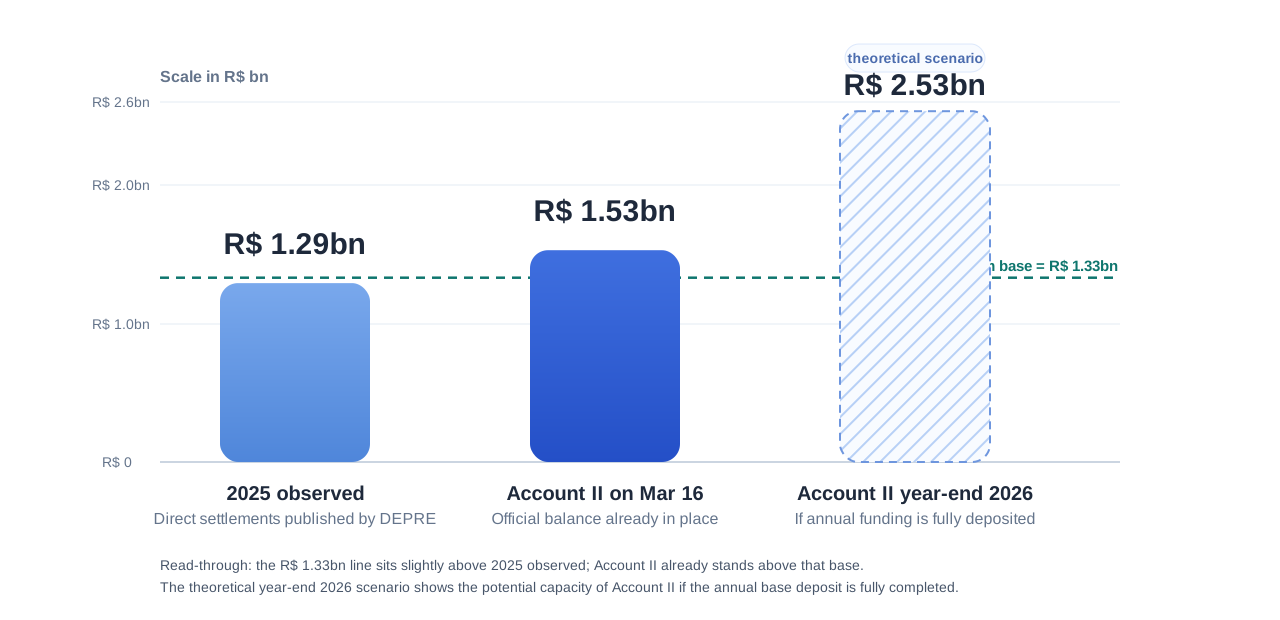
If we apply the 1% of 2025 RCL rule to 2026, the annual base deposit for FESP reaches R$ 2,662,438,818.07.
If 50% of that amount goes to direct settlements, the minimum annual funding base for the direct-settlement account (Account II) reaches R$ 1,331,219,409.03.
The second building block is the balance already standing in the direct-settlement account. In the official TJSP report as of March 16, 2026, FESP showed R$ 1,529,518,159.35 in Account II.
The third building block is fresh-year inflow. In the TJSP deposits report issued on March 18, 2026, FESP had already deposited R$ 327,310,342.90 into the direct-settlement account during 2026. That represents 24.59% of the annual direct-settlement base, leaving R$ 1,003,909,066.13 still to be deposited to complete the minimum annual base.
If we add the official March 16 balance to that remaining theoretical 2026 deposit, the direct-settlement account would point to R$ 2,533,427,225.48 before additional outflows during the rest of the year.
This should not be read as immediate settlement capacity. It should be read more soberly: the direct-settlement channel still appears funded.
Historical evidence: direct settlements have not been a residual mechanism
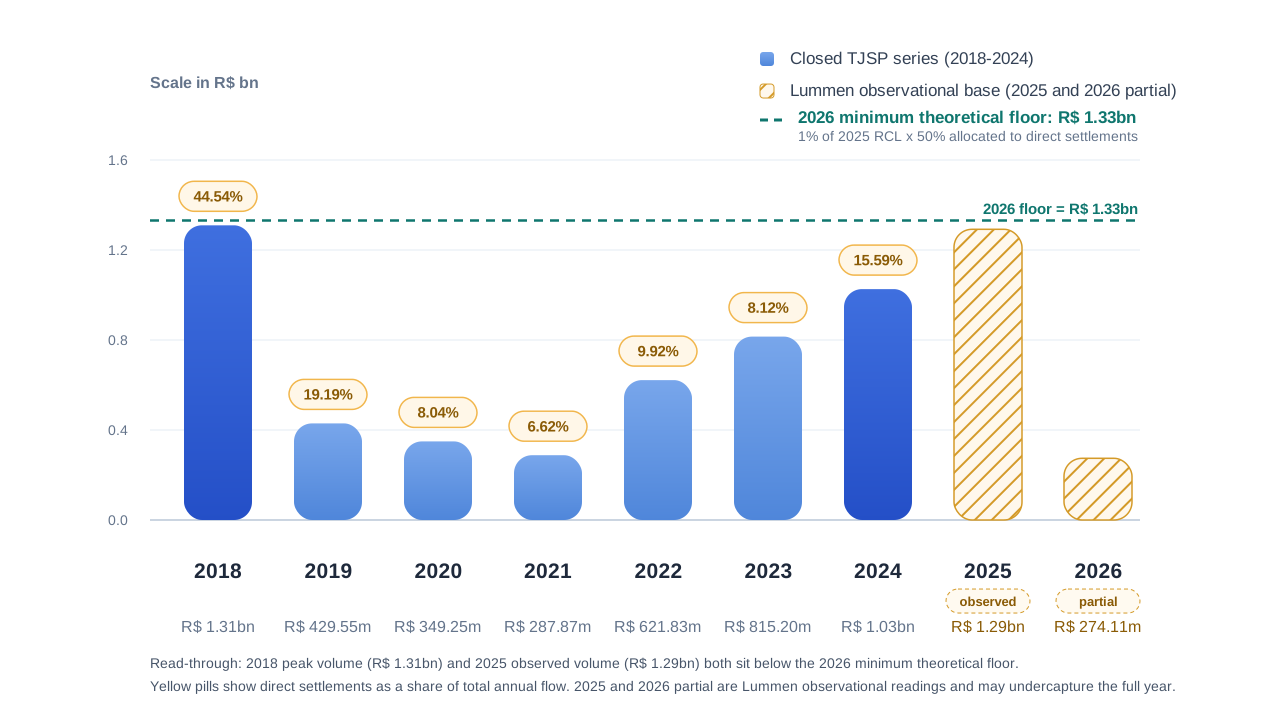
TJSP history supports the view that direct settlements are not a marginal mechanism in Sao Paulo. They already represented material scale in multiple years of the public series from 2018 to 2024.
| Year | Priority | Chronological queue | Direct settlements | Total annual flow | Settlements / total |
|---|---|---|---|---|---|
| 2018 | R$ 498,209,677.00 | R$ 1,133,075,377.73 | R$ 1,309,822,835.94 | R$ 2,941,107,890.67 | 44.54% |
| 2019 | R$ 1,255,341,081.09 | R$ 553,035,472.39 | R$ 429,546,192.80 | R$ 2,237,922,746.28 | 19.19% |
| 2020 | R$ 658,771,163.44 | R$ 3,334,151,368.02 | R$ 349,245,264.33 | R$ 4,342,167,795.79 | 8.04% |
| 2021 | R$ 917,260,633.71 | R$ 3,142,500,441.01 | R$ 287,868,893.79 | R$ 4,347,629,968.51 | 6.62% |
| 2022 | R$ 1,073,933,964.02 | R$ 4,575,499,627.50 | R$ 621,825,332.72 | R$ 6,271,258,924.24 | 9.92% |
| 2023 | R$ 3,310,627,618.28 | R$ 5,918,437,370.05 | R$ 815,200,898.55 | R$ 10,044,265,886.88 | 8.12% |
| 2024 | R$ 2,439,354,673.50 | R$ 3,116,279,549.03 | R$ 1,026,167,791.20 | R$ 6,581,802,013.73 | 15.59% |
The strongest closed-series data point is 2018, when direct settlements reached R$ 1.31 billion.
Lummen's observational reading of the public DEPRE settlement releases adds two more datapoints:
- 2025 observed direct settlements: R$ 1,292,062,745.00
- 2026 partial through March 19, 2026: R$ 274,108,799.00
In other words, the minimum 2026 funding base stands only R$ 39.16 million above the 2025 observed reading.
That does not prove immediate monetization. But it weakens the view that EC 136/2025 immediately broke the economics of the Sao Paulo direct-settlement route.
It is also important to qualify the data. 2025 and 2026 partial are observational, not closed official annual series. They are based on DEPRE's public settlement releases and may therefore undercapture the full annual volume.
Economics under an illustrative entry assumption
If an underwriting model assumes an illustrative purchase at 44% of face value and monetization through a 60% of face value direct settlement, the nominal spread is straightforward. The 44% input is a scenario assumption, not a statement of a current market-clearing price:
- purchase price: 44% of face
- direct-settlement proceeds: 60% of face
- gross gain in face points: 16 points
- gross return on invested capital: 36.36%
That is a hypothetical 36.36% gross return on invested capital, not an annualized return or a statement of actual performance. Taxes, fees, legal and operating costs, time to cash and FX are excluded. The key point is not the arithmetic alone, but whether the claim can move cleanly through the legal-operational path from assignment to settlement enrollment and final cash realization.
Where the risk sits in practice
At this stage, the sensitive point appears less macro and more legal-operational within the execution of the strategy itself.
The main underwriting workstreams appear to be:
- Perfection and regularization of the assignment at source.
- Documentary compliance for recognition of the assignment, including the requirements applied by the Sao Paulo State Attorney's Office and TJSP routines.
- Time from acquisition to court recognition, habilitation, and effective settlement enrollment.
- Processing friction between funded settlement capacity and actual cash realization.
That is why Sao Paulo should be read less as a story of channel failure and more as a case where edge comes from controlling the legal-servicing pipeline with speed and rigor.
ADI 7873 and the upside asymmetry
There is also a second-order layer of optionality in the trade: ADI 7873.
If Brazil's Supreme Court revisits economically relevant mechanics of EC 136/2025, especially on interest, timing, or the practical reach of certain constraints, investors who entered under the harsher regime may capture favorable repricing.
That should not replace the base underwriting model. The base case still has to rest on funding, execution discipline, and time to cash. But it is real optionality and should not be ignored.
Historical March conclusion and its current limitation
As of March 19, 2026, the public data do not support the view that Sao Paulo's direct-settlement route has been structurally impaired by EC 136/2025.
The more accurate formulation is this: the thesis remains intact, but it should be priced as operational duration risk rather than as immediate-liquidity certainty.
For U.S. allocators, the practical implication is not that Brazil became easy. It is that Sao Paulo can still support a defendable direct-settlement strategy, provided the process is built around jurisdiction-specific execution, disciplined assignment servicing, realistic time-to-cash underwriting, and separate treatment of FX, tax, vehicle structure, and repatriation.
The May notice narrows this March conclusion: an executable strategy must satisfy the queue-year restriction and price the possibility that eligible agreements exceed the available annual resources.
Related reading
- Why Now May Be a Compelling Entry Window for Brazilian Precatorios
- Duration Risk in Brazilian Precatorios: How to Underwrite Time to Cash
- Brazilian Precatorio Post-Acquisition Lifecycle: Assignment Registration, Payment Queue, and Cash Realization
- Currency, Tax, and Repatriation Considerations for Foreign Investors in Brazilian Precatorios
Sources
- FESP Settlement Notice 01/2026 — DJE May 29, 2026, pages 7–9
- EC 136/2025
- Decree No. 70,432 of March 10, 2026 (Sao Paulo Legislative Assembly repository)
- CNJ Resolution 303/2019
- TJSP Precatorios Portal
- SICONFI / Brazilian Treasury
Leonard da Rosa
Director of Financial Business
www.lummenativos.com.br
Lummen
Speak with Lummen
For questions about the methodology or official-source references, contact our research team.
